Self-care
Home Hand Therapy
A simple daily routine to keep the hand moving, reduce swelling, and prevent stiffness. Use after an injury, a cast removal, a steroid injection, or during the early weeks after surgery (when we have told you it is safe to move).
How to use this routine
- Do the full routine 3 to 5 times per day. Each session takes 5 to 10 minutes.
- Every exercise is active — you move the finger with your own muscles. No pushing or forcing.
- A mild stretch or mild discomfort is acceptable. Sharp pain is a signal to back off.
- If you were given specific restrictions after surgery, those override anything on this page. When in doubt, call the office.
1. Warm up with elevation and edema control
- Elevate the hand above the level of your heart for 3 to 5 minutes before starting. Rest it on pillows or lean back and hold the hand straight up.
- Pump the fingers — make a light fist and open fully — about 30 times with the hand elevated.
- If the hand is swollen, "milk" the swelling from the fingertips toward the wrist with gentle stroking pressure using your other hand. This is called retrograde massage.
2. Tendon gliding (the core exercise for the hand)
Tendon gliding moves the flexor tendons through their full range, which is the single best exercise for preventing finger stiffness. Do 10 repetitions of each position, holding each for about 3 seconds before moving on.
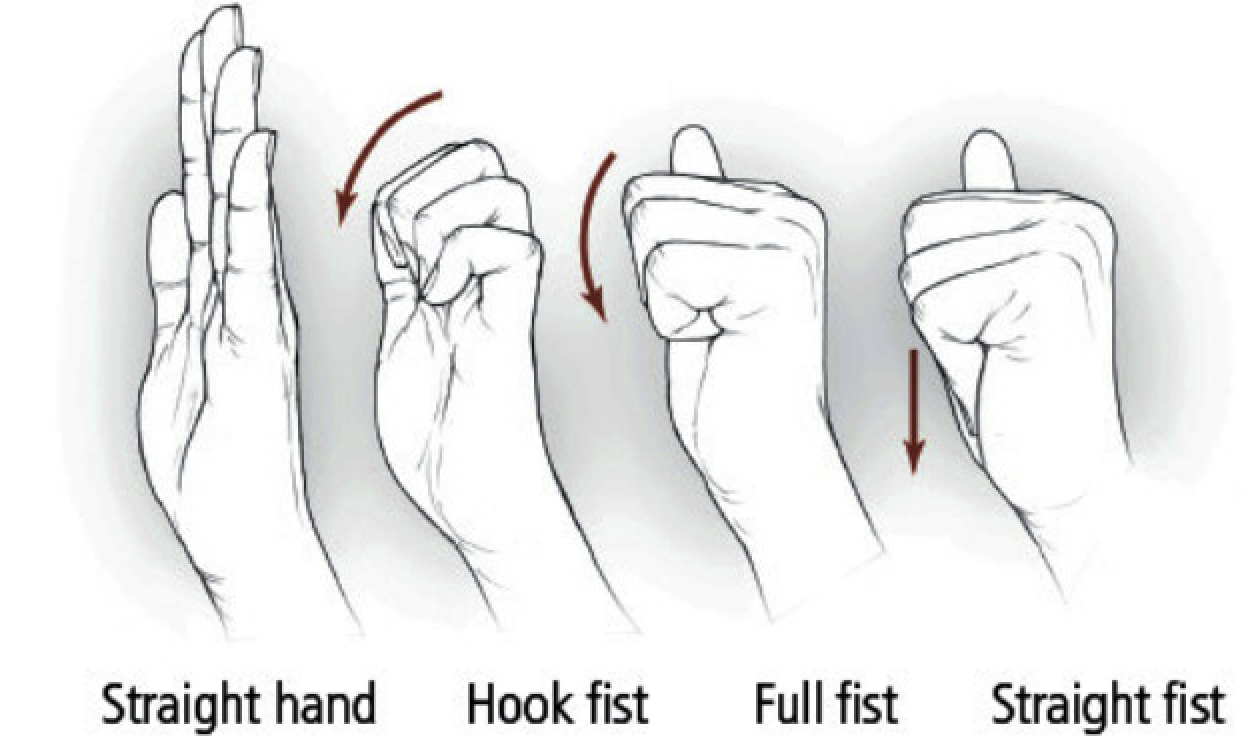
- Position 1 — Straight hand. Fingers and thumb fully straight, palm open.
- Position 2 — Hook fist. Bend only the knuckles closest to the fingernail and the middle knuckles. Keep the big knuckles at the base of the fingers straight. The fingertips should touch the pads just under the fingers.
- Position 3 — Full fist. Bend all three joints of each finger and close into a tight fist, with the thumb wrapped over the outside.
- Position 4 — Straight fist. Start from a full fist, then straighten just the fingertip joint so the fingertips point forward while the middle and big knuckles stay bent. The fingernails should line up with each other.
- Position 5 — Tabletop. From straight, bend only the big knuckles so the fingers form a 90-degree "tabletop" shape, while the two finger joints stay straight.
3. Intrinsic-plus position
The small muscles inside the hand are called the intrinsics, and they get tight quickly after an injury. Putting the hand in the "intrinsic-plus" position stretches them and keeps them supple.
- Start with a tabletop: big knuckles bent to 90 degrees, finger joints straight.
- Hold for 10 seconds, relax, repeat 10 times.
- This is also the position the hand should be in if you have to wear a resting splint — it keeps the collateral ligaments at their longest length.
4. Composite fist
The composite fist is a full fist combined with a flexed wrist, which gives the maximum stretch to the extensor tendons on the back of the hand. Do 10 repetitions, holding each for 3 to 5 seconds.
- Make a full, tight fist.
- Keeping the fist closed, gently bend the wrist downward (flexion).
- Hold, then release by straightening the fingers and the wrist together.
5. Wrist active range of motion
- Flexion and extension. Bend the wrist up, then down, as far as it will go comfortably. 10 repetitions.
- Radial and ulnar deviation. With the forearm resting on a table and the hand off the edge, bend the wrist side to side, thumb side and small-finger side. 10 repetitions.
- Supination and pronation. With the elbow tucked at your side and bent 90 degrees, rotate the palm up and then down. 10 repetitions.
6. Thumb mobility
- Thumb opposition. Touch the thumb to each fingertip in turn, then back the other way. 2 full passes.
- Thumb IP flexion. Bend just the tip of the thumb up and down 10 times.
- Thumb circumduction. Draw small, slow circles with the thumb tip — 5 in each direction.
7. Scar massage (after 2 weeks post-op, once the skin is closed)
- Apply a pea-sized drop of plain, unscented lotion, cocoa butter, or vitamin E cream to the scar.
- Using the pad of your finger, press firmly and massage in small circles directly over the scar for 2 to 3 minutes, twice a day.
- The goal is to soften the scar and break up tight bands underneath. Mild redness during massage is expected; pain is not.
- Keep the scar out of direct sun for the first year, or use sunscreen. New scars darken easily with sun exposure.
8. Desensitization (if the area is hypersensitive)
Useful after nerve injury or any surgery where the skin feels oversensitive to touch. Rub the sensitive area for 2 to 3 minutes, several times a day, working through progressively rougher textures as tolerated:
- Soft cotton or silk
- A clean, dry washcloth
- A soft brush
- A stiffer brush, coarse fabric, or rice
Sensitivity usually improves over weeks to a few months.
If the hand remains stiff, weak, or swollen after 3 to 4 weeks of consistent home therapy — or if these exercises are causing pain rather than mild discomfort — a few sessions with a certified hand therapist are usually the right next step. Hand therapists have specific tools (custom splints, ultrasound, manual mobilization, graded strengthening) that can unlock progress when home exercises have plateaued.
- Sudden, sharp pain during an exercise
- A "pop" or sudden inability to bend or straighten a finger
- New numbness or tingling that does not go away
- Worsening swelling, warmth, or redness in the hand
- Any exercise that repeatedly triggers severe pain
Related
Questions?
Call your office location for non-urgent questions:
- NYU Langone Laurelton · 646-501-4950
- NYU Orthopedic, Woodside · 929-429-3222
- NYU Orthopedic, Richmond Hill · 718-206-6923
- Jamaica Hospital Ambulatory Care Center (ACC) · 718-301-0720
See our office contact information for addresses and fax numbers.