Condition
Flexor Tendon Injury
A cut or rupture of the tendons that bend your fingers. Needs prompt surgery and careful hand therapy to heal well.
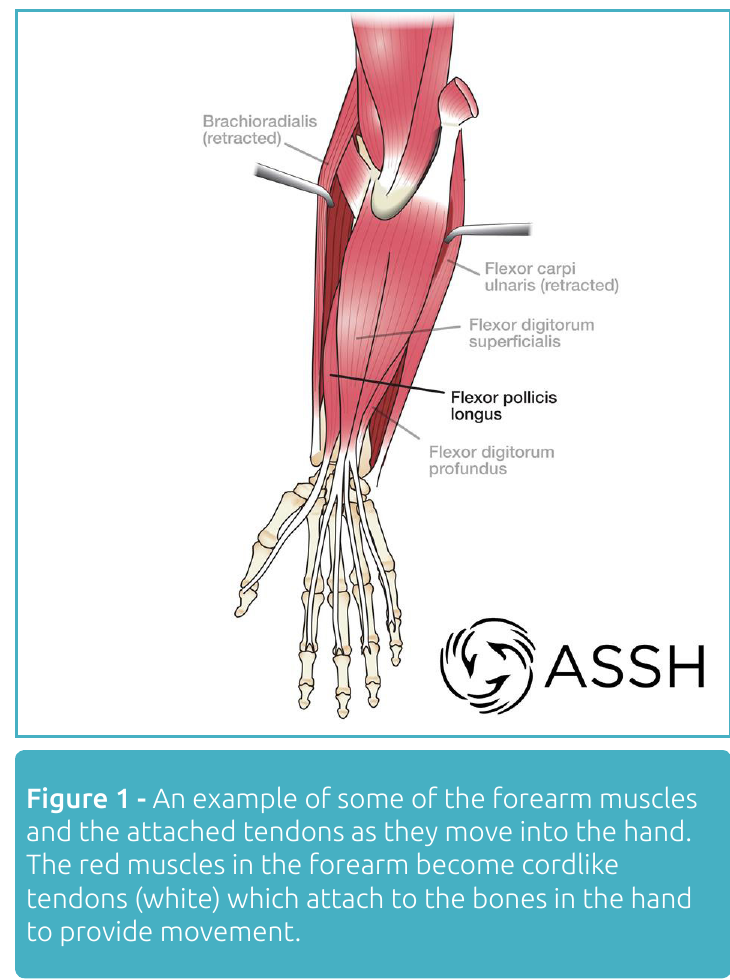
Illustration © American Society for Surgery of the Hand
What is a flexor tendon injury?
Each finger is bent by two flexor tendons that run from the forearm, through the palm, and into the finger. If one of these tendons is cut — most often by a knife, a piece of glass, or a saw — the finger can no longer bend at one or both of its joints. Because the tendons run inside a tight tunnel in the finger, the ends retract like a rubber band when cut, so these injuries almost always require surgery to repair.
Common symptoms
- A cut on the palm side of the hand or finger, often from a knife or glass
- Inability to bend the fingertip, the middle joint of the finger, or both
- A finger that rests straighter than its neighbors when the hand is relaxed
- Numbness in the finger if the nearby nerve is also cut
- Sometimes a "pop" felt during a forceful grip, such as grabbing a jersey (jersey finger)
Why does it happen?
Most flexor tendon injuries are from sharp lacerations: kitchen knives, broken glass, box cutters, and saws. They can also happen when a finger is forcibly straightened during a powerful grip, which can avulse the tendon off the bone at the fingertip (jersey finger, common in football and rugby).
Treatment options
Non-surgical treatment
- Limited role. Almost all complete tendon lacerations need surgical repair to regain finger motion. Splinting alone is only considered for partial tears or in rare situations where surgery is not possible.
Surgical treatment
- Primary tendon repair. The cut tendon ends are found and sewn back together, usually within 1 to 2 weeks of the injury. The wound is also cleaned and any cut nerves are repaired at the same time.
- Tendon grafting or reconstruction. If the injury is older or the tendon has scarred or shortened, a staged reconstruction with a tendon graft may be needed.
- Hand therapy. Therapy is every bit as important as the surgery itself. You will start a protected motion program within days of surgery, continuing for several months, to prevent the repaired tendon from scarring down.
What to expect at your visit
Dr. Barrera will examine each finger position at rest, test each tendon individually, and check sensation in the finger. If a tendon is cut, surgery should be scheduled within 7 to 14 days for the best outcome. After surgery you will be placed in a specific splint and seen by a certified hand therapist within a few days to start early motion. The first three months after surgery are critical — following the therapy plan closely is the single biggest factor in a good result.
Seek emergency care for any cut to the hand that is bleeding heavily, for any laceration with loss of finger movement or numbness, or for a "pop" during gripping followed by a finger that cannot bend at the tip. Older flexor tendon injuries are harder to repair, so earlier is better.
Related
Questions?
Call your office location for non-urgent questions:
- NYU Langone Laurelton · 646-501-4950
- NYU Orthopedic, Woodside · 929-429-3222
- NYU Orthopedic, Richmond Hill · 718-206-6923
- Jamaica Hospital Ambulatory Care Center (ACC) · 718-301-0720
See our office contact information for addresses and fax numbers.