Condition
Extensor Tendon Injuries
Cuts, tears, or ruptures of the tendons on the back of your hand and fingers that straighten your joints.
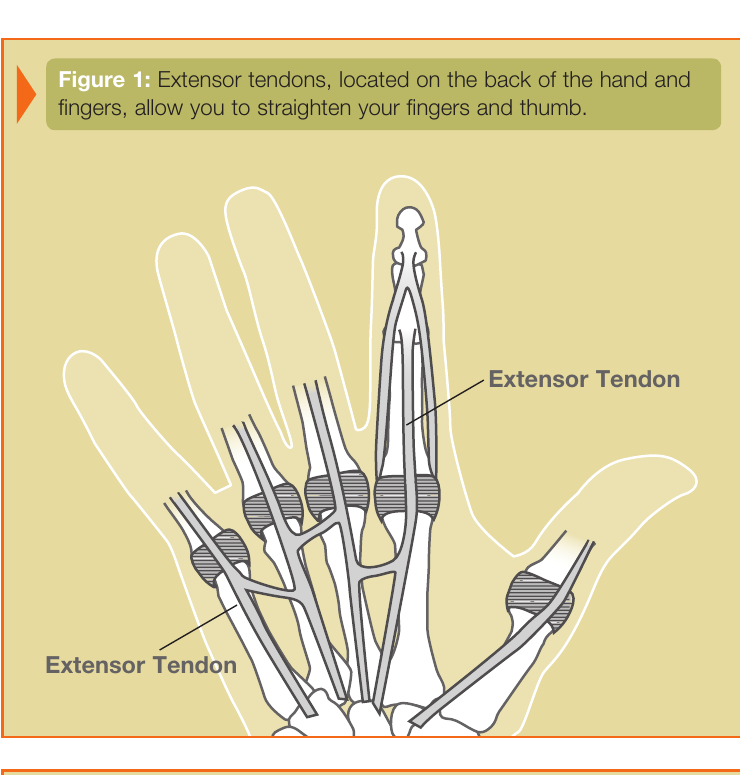
Illustration © American Society for Surgery of the Hand
What is an extensor tendon injury?
Extensor tendons are the cords on the back of your hand, fingers, and thumb. They lie just under the skin, right over the bones. When you open your hand and straighten your fingers, these tendons do the work. Because they sit so close to the surface, they can be hurt by a small cut, a jam to the fingertip, or a blow to the back of the hand. When an extensor tendon is cut or torn, the affected joint will not straighten normally.
Common symptoms
- Inability to fully straighten one or more finger joints
- A drooping fingertip (mallet finger) or a bent middle joint that cannot be straightened (boutonnière deformity)
- Pain, swelling, or bruising on the back of the finger or hand
- A cut, puncture, or laceration on the back of the hand or finger
- Weakness when trying to open the hand
Why does it happen?
There are three common ways extensor tendons get hurt:
- A cut on the back of the hand or finger from a knife, glass, or a sharp edge. Even a small-looking cut can divide the tendon underneath.
- A jam to the fingertip (a ball hits the end of the finger, or the finger catches on a sheet or jersey). This can rupture the tendon from its bone attachment.
- A blow to the middle joint of the finger. This can tear the central slip and cause a boutonnière deformity.
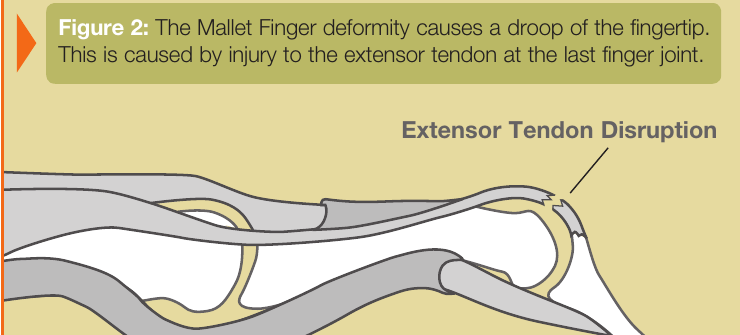
Illustration © American Society for Surgery of the Hand
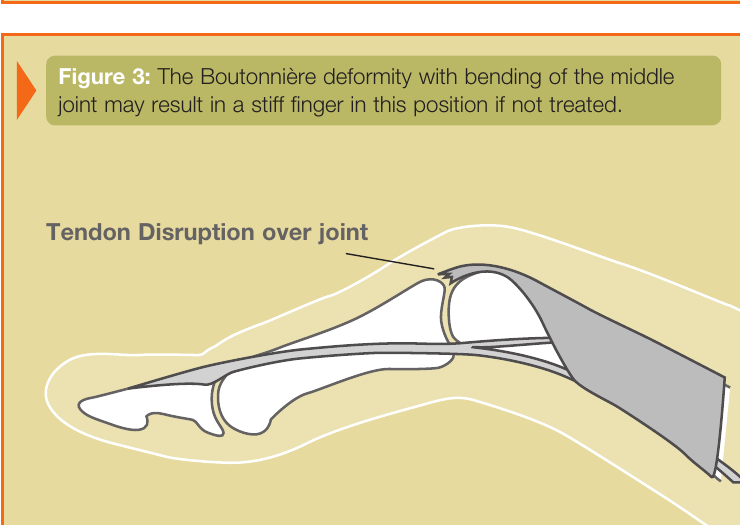
Illustration © American Society for Surgery of the Hand
Treatment options
Non-surgical treatment
- Splinting. Many closed extensor tendon injuries heal well in a splint that holds the joint straight. Mallet finger and some boutonnière injuries are treated this way. The splint typically stays on full-time for 6 to 8 weeks, then part-time for a few more weeks.
- Hand therapy. A certified hand therapist custom-fits the splint and teaches you how to care for the finger while it heals.
Surgical treatment
- Tendon repair. If the tendon is cut, it usually needs to be sewn back together. This is an outpatient surgery, often done with local or regional numbing.
- Pin across the joint. Some injuries are treated by placing a small pin through the bone as an internal splint while the tendon heals.
- Later reconstruction. If an injury was missed or healed poorly, a secondary procedure may be needed to restore finger position and movement.
After surgery or splinting, hand therapy is almost always part of recovery. It helps the tendon glide again and prevents stiffness.
What to expect at your visit
Dr. Barrera will examine your hand, test each joint for active extension, and review any imaging if you have it. X-rays are often taken to look for a small bone fragment that can come off along with the tendon. Based on which tendon is involved, whether the skin is cut, and how long it has been since the injury, you will discuss splinting versus surgery together.
Call us if you have a deep cut on the back of your hand or finger, if you cannot straighten a finger joint after an injury, if the skin around a wound is red or draining, or if you have a fever along with the injury.
Related
Questions?
Call your office location for non-urgent questions:
- NYU Langone Laurelton · 646-501-4950
- NYU Orthopedic, Woodside · 929-429-3222
- NYU Orthopedic, Richmond Hill · 718-206-6923
- Jamaica Hospital Ambulatory Care Center (ACC) · 718-301-0720
See our office contact information for addresses and fax numbers.