Condition
Boutonnière Deformity
An injury to the central tendon over the middle joint of the finger that makes it hard to straighten the joint.
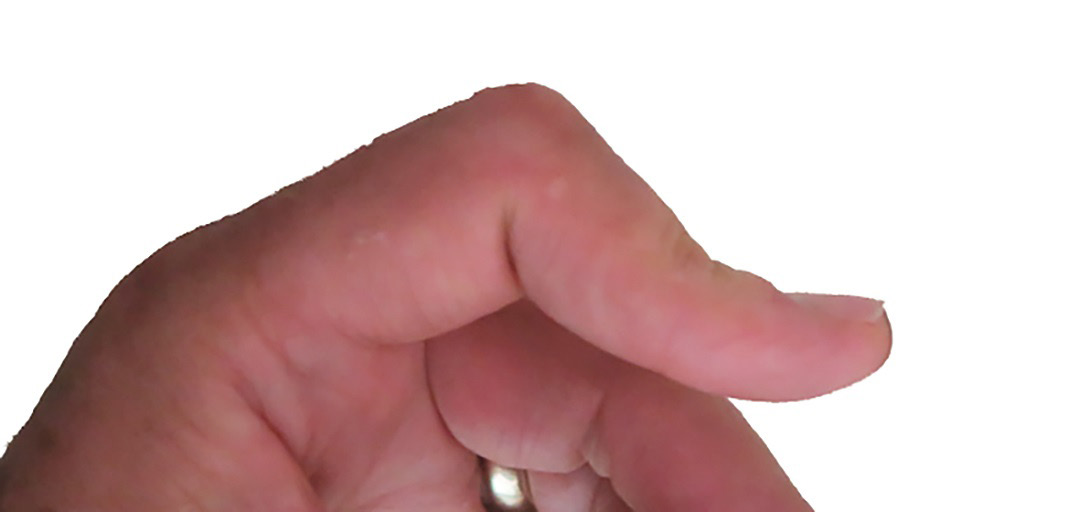
Illustration © American Society for Surgery of the Hand
What is a boutonnière deformity?
A boutonnière (buttonhole) deformity happens when the central part of the extensor tendon, called the central slip, is injured where it attaches over the middle joint of the finger. When the central slip is torn, the middle joint drops into a bent position and the fingertip snaps up into a straight or hyperextended position. The finger looks like it is being pushed through a buttonhole, which is where the name comes from.
Common symptoms
- Swelling and pain over the back of the middle joint of the finger
- The middle joint bends and cannot be fully straightened
- The fingertip sits in a hyperextended position
- Trouble straightening the finger to put on gloves or reach into a pocket
- Tenderness on the top of the PIP joint (the middle knuckle)
Why does it happen?
Boutonnière deformities usually come from one of three causes:
- A forced bend of the finger, such as when a ball hits the tip of a straight finger
- A cut on the back of the finger that divides the central slip
- Rheumatoid arthritis, which can stretch and weaken the central slip over time
If a fresh injury is missed, the deformity can become fixed over the next few weeks as the finger sits in the wrong position.
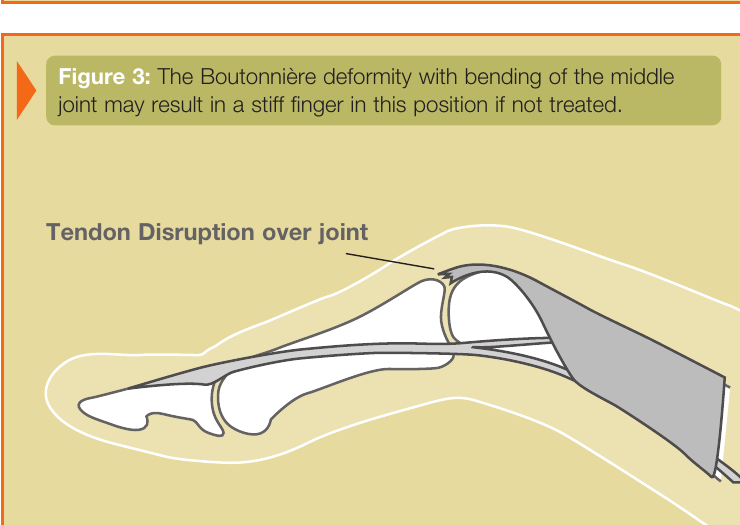
Illustration © American Society for Surgery of the Hand
Treatment options
Non-surgical treatment
- Splinting. A splint is applied that holds the middle joint fully straight while allowing the tip joint to bend. The splint is usually worn full-time for about 6 weeks, then gradually weaned. Hand therapy guides this process.
- Hand therapy exercises. Bending the tip joint while the middle joint is splinted helps the tendon heal in the right length and keeps the finger from getting stiff.
Surgical treatment
- Direct repair. If the central slip is cut (for example, from a laceration), it is often sewn back together in the operating room.
- Reconstruction. If the injury is old or the finger is locked in the boutonnière position, tendon reconstruction may be needed to restore balance to the finger.
What to expect at your visit
Dr. Barrera will examine the finger and test how well you can straighten the middle joint against gentle resistance. X-rays are often obtained to look for a small bone fragment. Early, closed boutonnière injuries usually do very well with splinting if treatment starts soon after the injury. Getting evaluated within the first week or two makes a real difference.
Call us if you cannot fully straighten the middle joint of a finger after an injury, if the top of the middle knuckle is very swollen and tender, or if there is a cut on the back of the finger over the middle joint.
Related
Questions?
Call your office location for non-urgent questions:
- NYU Langone Laurelton · 646-501-4950
- NYU Orthopedic, Woodside · 929-429-3222
- NYU Orthopedic, Richmond Hill · 718-206-6923
- Jamaica Hospital Ambulatory Care Center (ACC) · 718-301-0720
See our office contact information for addresses and fax numbers.