Condition
Dupuytren's Contracture
A slow thickening of the tissue under the skin of the palm that can pull the fingers into a bent position over time.
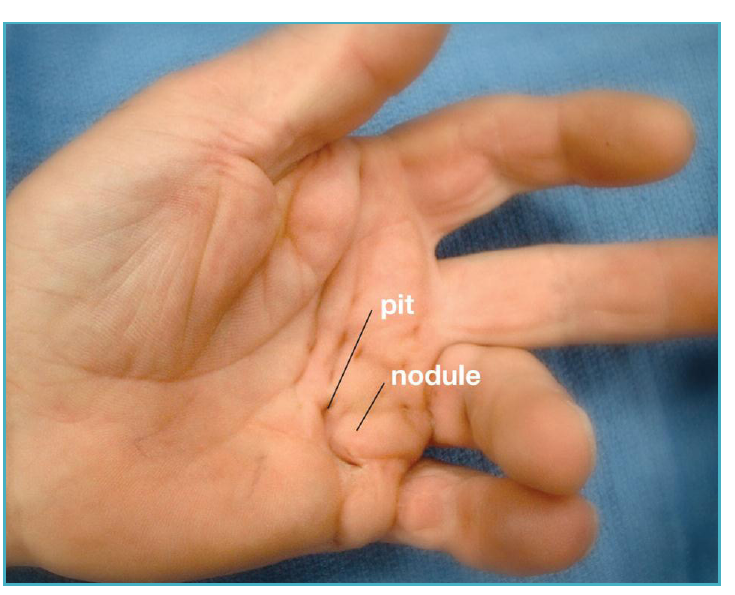
Illustration © American Society for Surgery of the Hand
What is Dupuytren's contracture?
Dupuytren's contracture is a condition in which the layer of tissue just under the skin of the palm (called the palmar fascia) slowly thickens and forms firm cords. Over years, those cords can shorten and pull one or more fingers into a bent position that you cannot fully straighten. The ring and small fingers are most often involved. It is generally not painful, but as it progresses it can make everyday tasks like putting on gloves, washing your face, or shaking hands difficult.
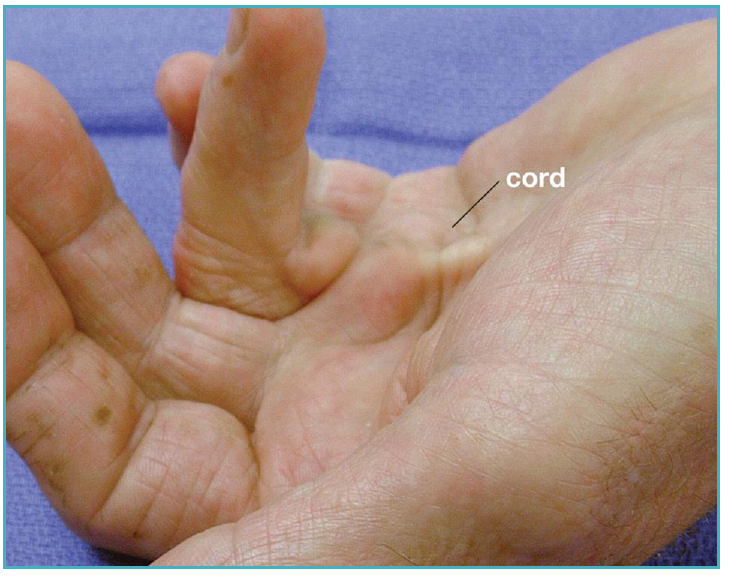
Illustration © American Society for Surgery of the Hand
Common symptoms
- A firm lump or pit in the palm, often at the base of the ring or small finger
- A rope-like cord that runs from the palm into the finger
- A finger that will not lay flat on a table (the "tabletop test")
- Trouble putting your hand in a pocket or glove
- Usually no pain, though the nodules can feel tender early on
Why does it happen?
Dupuytren's is largely genetic. It is more common in people of northern European ancestry, in men more than women, and in people over 50. Diabetes, smoking, and a family history increase the risk. It is not caused by work or hand use.
Treatment options
Non-surgical treatment
- Observation. A small nodule with no contracture does not need treatment. We watch it and treat only if the finger starts to bend.
- Needle aponeurotomy. A small needle is used in the office to perforate the cord in several places until it snaps, allowing the finger to straighten. Recovery is fast. The cord can come back over time.
- Enzyme injection (collagenase). An injection into the cord weakens it, and the finger is straightened a day or two later. Not all patients are candidates.
Surgical treatment
- Fasciectomy. The diseased tissue is carefully removed through an incision in the palm and finger. This gives the most complete correction and the lowest recurrence rate, at the cost of a longer recovery and hand therapy.
What to expect at your visit
Dr. Barrera will examine your hand, measure how much each joint is bent, and perform the tabletop test. Treatment is usually recommended when a knuckle cannot fully straighten (usually around 30 degrees of contracture) or when the finger joint is becoming stuck. You will review the options above and pick the one that fits your hand, your tolerance for recovery time, and your risk of recurrence.
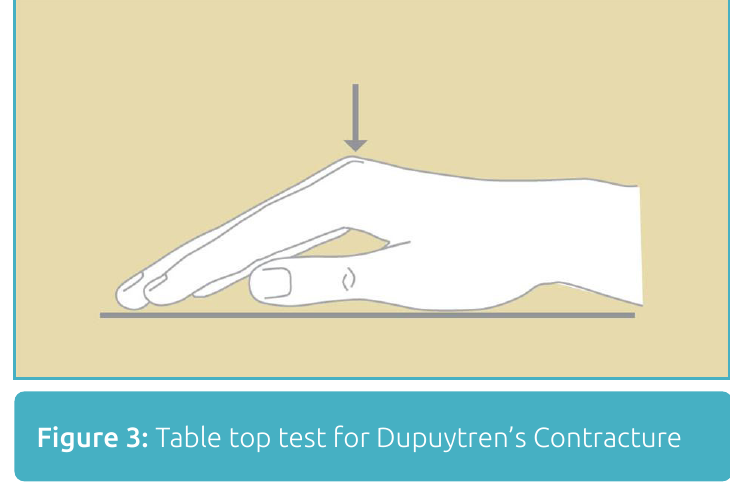
Illustration © American Society for Surgery of the Hand
Call us if you notice the finger bending down quickly over weeks rather than years, if you develop skin breakdown in the palm crease, or if you have new pain, redness, or warmth after a recent injection or procedure.
Questions?
Call your office location for non-urgent questions:
- NYU Langone Laurelton · 646-501-4950
- NYU Orthopedic, Woodside · 929-429-3222
- NYU Orthopedic, Richmond Hill · 718-206-6923
- Jamaica Hospital Ambulatory Care Center (ACC) · 718-301-0720
See our office contact information for addresses and fax numbers.