Condition
De Quervain's Tenosynovitis
Painful inflammation of the thumb tendons at the wrist. Often resolves with splinting and a single steroid injection.
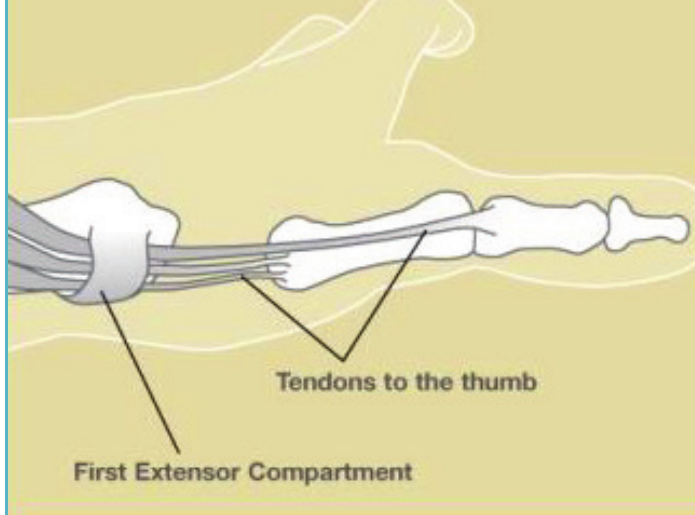
Illustration © American Society for Surgery of the Hand
What is De Quervain's?
Two tendons that move your thumb share a tight tunnel along the thumb side of the wrist. When the lining of that tunnel becomes inflamed, the tendons cannot glide smoothly and every thumb motion becomes painful. This is De Quervain's tenosynovitis.
Common symptoms
- Pain on the thumb side of the wrist, just above the base of the thumb
- Pain that gets worse when pinching, lifting, or wringing
- Swelling over the wrist, and sometimes a catching or snapping feeling
- Difficulty lifting a baby, a coffee pot, or a shopping bag
Why does it happen?
De Quervain's is often seen in new parents (sometimes called "mommy thumb") because of the way infants are lifted, and in people who do a lot of repetitive thumb motion. It is also more common during and after pregnancy and in people over 40. Sometimes it appears without any clear cause.
Treatment options
Non-surgical treatment
- Thumb splint. A splint that holds the thumb and wrist still lets the inflamed tendons rest. It is most effective in the first few weeks.
- Activity changes. Avoiding the motions that provoke pain, especially sideways wrist bending while pinching.
- Steroid injection. A cortisone injection into the tendon tunnel is very effective and cures the problem for most patients, often after a single shot.
Surgical treatment
- First dorsal compartment release. If splinting and injections do not work, a small surgery opens the tight tunnel to give the tendons more room. It is a short outpatient procedure done under local numbing through a small incision on the side of the wrist.
What to expect at your visit
Dr. Barrera will ask about your symptoms and examine your wrist, including a maneuver that reproduces the pain by bending your wrist with the thumb tucked in. The diagnosis is usually clear from the exam alone and imaging is rarely needed.
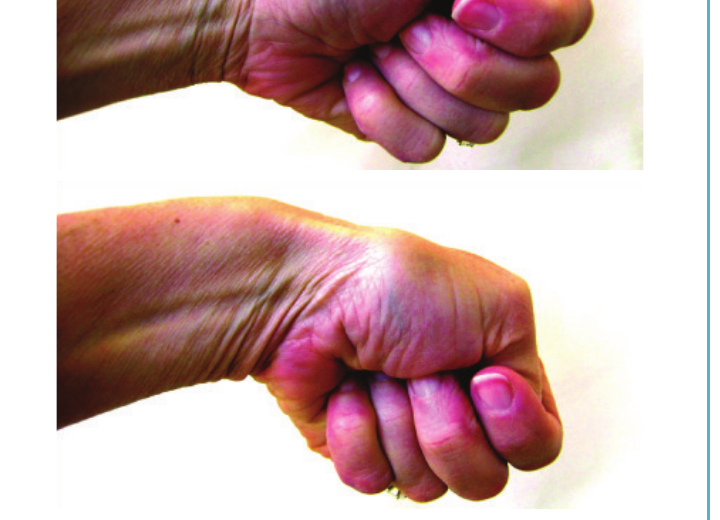
Illustration © American Society for Surgery of the Hand
Call us if the wrist becomes hot, very swollen, or red, if you have a fever, or if you notice an open wound or recent cut near the painful area.
Questions?
Call your office location for non-urgent questions:
- NYU Langone Laurelton · 646-501-4950
- NYU Orthopedic, Woodside · 929-429-3222
- NYU Orthopedic, Richmond Hill · 718-206-6923
- Jamaica Hospital Ambulatory Care Center (ACC) · 718-301-0720
See our office contact information for addresses and fax numbers.