Condition
TFCC Tear
A tear of the small cartilage and ligament pad on the pinky side of the wrist. A common cause of ulnar-sided wrist pain.
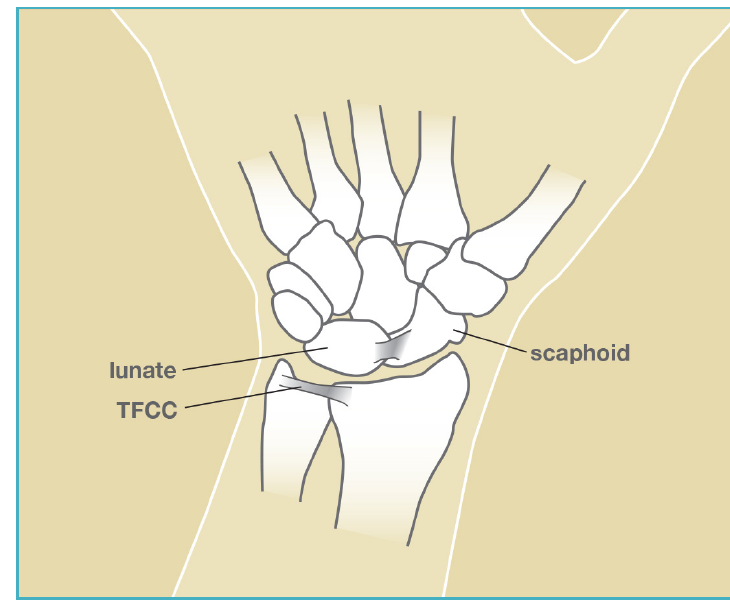
Illustration © American Society for Surgery of the Hand
What is a TFCC tear?
The triangular fibrocartilage complex (TFCC) is a small disc of cartilage and ligaments on the pinky (ulnar) side of the wrist. It acts as a cushion between the forearm bones and the wrist bones, and helps keep the two forearm bones stable when you rotate your hand. A TFCC tear is a disruption of this cushion, from a sudden injury or gradual wear.
Common symptoms
- Pain on the pinky side of the wrist
- Pain that is worse with forearm rotation (turning a key, opening a doorknob) or pushing off the wrist
- A clicking, catching, or popping feeling
- A sense that the wrist is weak or unstable
- Swelling or aching after activity
Why does it happen?
TFCC tears happen two ways. A traumatic tear is caused by a specific injury, most often a fall on an outstretched hand or a forceful twist of the wrist. A degenerative tear happens slowly with age, and is more common in people whose ulna bone is slightly longer than their radius (a normal variant called ulnar-positive variance). Activities that load the wrist while rotated, like racquet sports and gymnastics, can bring symptoms out.
Treatment options
Non-surgical treatment
- Wrist splint. A wrist splint or brace for several weeks can calm the tear and often resolves symptoms, especially for degenerative tears.
- Activity modification. Temporarily avoiding the motions that cause pain (gripping while rotating) helps the tear quiet down.
- Steroid injection. A cortisone injection into the TFCC can reduce inflammation and pain.
- Therapy. Hand therapy to strengthen the wrist stabilizers is useful once pain is controlled.
Surgical treatment
- Arthroscopic debridement or repair. If conservative care does not work, a small camera is used to look inside the wrist and either trim a frayed edge or stitch the torn edges back together. Which is best depends on where the tear is and how much of the TFCC is involved.
- Ulnar shortening osteotomy. In patients with ulnar-positive variance whose TFCC is failing from overload, shortening the ulna bone takes pressure off the TFCC and often works well.
What to expect at your visit
Dr. Barrera will examine the wrist and perform specific tests that stress the TFCC to reproduce the pain. X-rays check the alignment of the forearm bones and the relative length of the ulna. If the diagnosis is unclear or if symptoms do not respond to first-line care, an MRI is the best test to see the TFCC directly.
Call us if a wrist injury is followed by severe swelling, loss of motion, or a wrist that looks visibly deformed. Sudden loss of grip strength or numbness in the hand also deserves prompt evaluation.
Questions?
Call your office location for non-urgent questions:
- NYU Langone Laurelton · 646-501-4950
- NYU Orthopedic, Woodside · 929-429-3222
- NYU Orthopedic, Richmond Hill · 718-206-6923
- Jamaica Hospital Ambulatory Care Center (ACC) · 718-301-0720
See our office contact information for addresses and fax numbers.